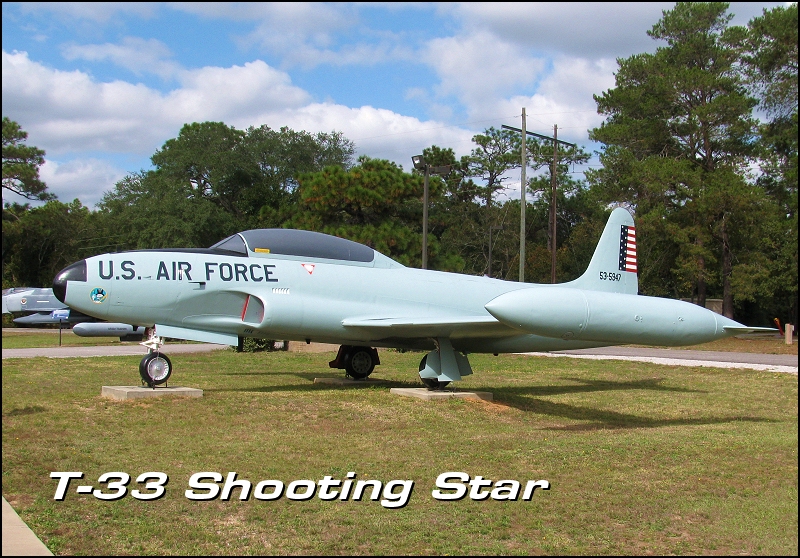
T-33
Shooting Star
Manufacturer:
First Flight:
Wingspan:
Length:
Height:
Weight:
Max Speed:
Cruising Speed:
Range:
Ceiling:
Power Plant:
Crew:
Armament:
Lockheed
March 22, 1948
38 ft. 10-1/2 in.
37 ft. 9 in.
11 ft. 8 in.
8,365 lbs.(empty), 12,071 lbs.(loaded),
15,061 lbs.(max. takeoff)
600 mph
455 mph
1,275 mi.
48,000 ft.
1x Allison J33-A-35 turbojet, 5,400 lbs. thrust
(water injection), 4,600 lbs. (continuous)
2
2 hardpoints with a 2,000 lbs. capacity of
bombs or rockets (AT-33)
The Lockheed T-33 Shooting Star (or T-Bird) is an American jet trainer aircraft. It was produced by Lockheed and made its first flight in 1948 piloted by Tony LeVier. The T-33 was developed from the Lockheed P-80/F-80 starting as TP-80C/TF-80C in development, then designated T-33A. It was used by the U.S. Navy initially as TO-2 then TV-2, and after 1962, T-33B. As of 2015, Canadian-built examples remain in service with the Bolivian Air Force.
As more advanced jets entered service, the T-33 took on another role — training jet pilots. The two-place T-33 jet was designed for training pilots already qualified to fly propeller-driven aircraft. Originally designated the TF-80C, the T-33 made its first flight on March 22, 1948 with U.S. production taking place from 1948 to 1959
The T-33 has served with over 30 nations, and continues to operate as a trainer in smaller air forces. Canadair built 656 T-33s on licence for service in the RCAF—Canadian Forces as the CT-133 Silver Star, while Kawasaki manufactured 210 in Japan. Other operators included Brazil, Turkey and Thailand which used the T-33 extensively.
Courtesy: Wikipedia
Return to Previous Page
Web Site, Photos, & Text Compilation created by:
Life's a Beach Staff © 2017 All Rights Reserved
Email: LifesaBeachPhotography.com