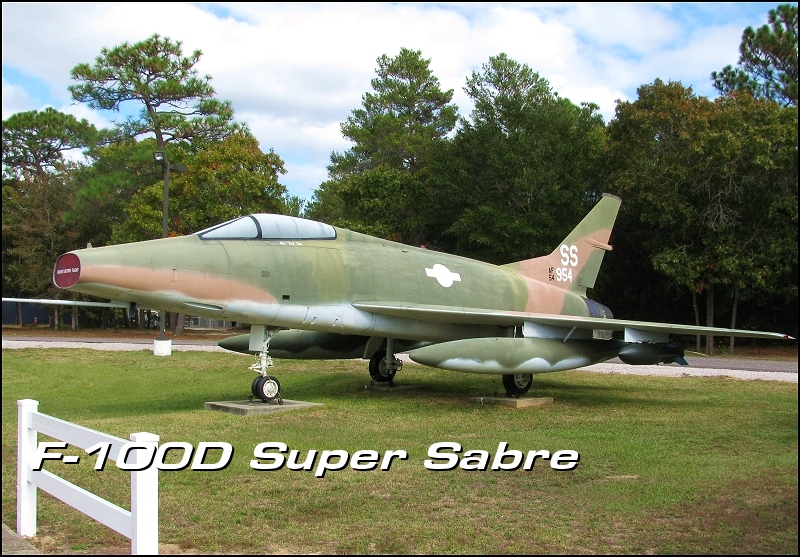
F-100D
Super Sabre
Specifications
Manufacturer:
First Flight:
Wingspan:
Length:
Height:
Weight:
Max Speed:
Cruising Speed:
Range:
Ceiling:
Power Plant:
Crew:
Armament:
North American Aviation
May 25, 1953
38 ft. 9 in.
50 ft.
16 ft. 3 in.
21,000 lb.(empty), 28,847 lb.(loaded),
34,832 lbs.(max. takeoff)
864 mph
587 mph
1,733 nm
50,000 ft.
1x Pratt & Whitney J57-P-21/21A turbojet
1
4x 20mm M39A1 revolver cannon, Missiles:
4x AIM-9 Sidewinder or 2x AGM-12 Bullpup
or 2x or 4x LAU-3/A unguided rocket
dispenser
The North American Aviation F-100 Super Sabre was a sleek, swept-back-wing fighter that gave the United States a supersonic Air Force. Although the first version was produced prior to 1950, various improved versions served as trainers and as active military craft at many U.S. and foreign bases.
Since May 1953, when the first prototype model, the YF-100, bettered the speed of sound on its first flight, the versatile fighter set numerous records for speed, endurance, range and maintenance.
Late production models of the F-100D and F-100F had the capability of being launched from remote areas in the manner of manned missiles. An F-100D Super Sabre became the first supersonic aircraft to be “boosted” airborne without use of a runway in successful Zero Length Launch (ZEL) tests at Edwards Air Force Base, Calif., in 1958.
In addition to its nuclear bomb armament and four 20 mm cannons, the Super Sabre could be equipped to fire rockets and missiles, including the heat-seeking GAR-8 Sidewinder.
The F-100 saw service in the Vietnam war until redeployment in 1971.
Courtesy: Wikipedia, Boeing
Return to Previous Page
Web Site, Photos, & Text Compilation created by:
Life's a Beach Staff © 2017 All Rights Reserved
Email: LifesaBeachPhotography.com