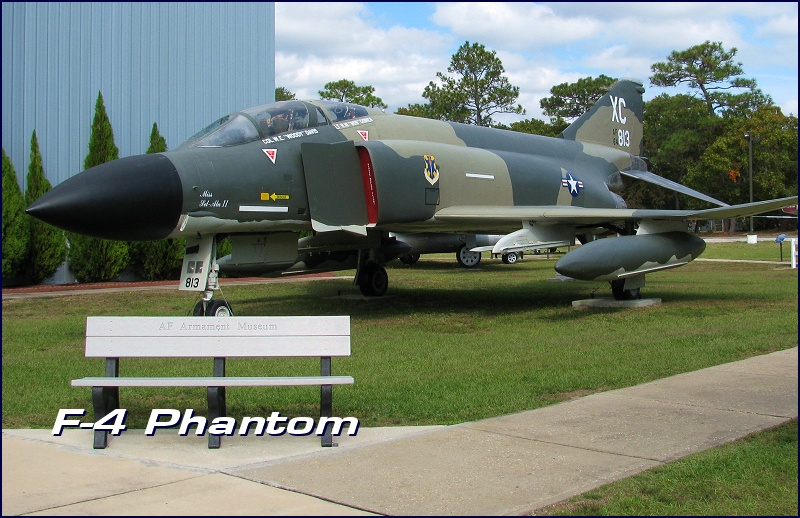
F-4E Specifications
Manufacturer:
First Flight:
Wingspan:
Length:
Height:
Weight:
Max Speed:
Cruising Speed:
Range:
Ceiling:
Power Plant:
Crew:
Armament:
McDonnell Aircraft Company
May 27, 1958 (prototype YF4H-1)
38 ft., 5 in.
63 ft.
16 ft., 6 in.
30,328 lbs.(Empty), 41,500 lbs.(Loaded),
61,795 lbs.(Max. Takeoff)
1,472 mph
585 mph
1,615 miles w/3 external fuel tanks
60,000 ft.
2 × General Electric J79-GE-17A
axial compressor turbojets, 11,905 lbs.
thrust; 17,845 lbs. with afterburner
Two - pilot, Radar Intercept Officer or
Weapon Systems Officer
Up to 18,650 lbs. of weapons on 9
external hard-points, including general
purpose bombs, cluster bombs, TV- and
laser-guided bombs, rocket pods, air-to-
ground & air-to-air missiles, anti-runway
weapons, anti-ship missiles, targeting
pods, reconnaissance pods, & nuclear
weapons. Baggage pods and external
fuel tanks may also be carried.
The McDonnell Douglas F-4 Phantom II is a tandem two-seat, twin-engine, all-weather, long-range supersonic jet interceptor fighter/fighter-bomber originally developed for the United States Navy by McDonnell Aircraft. It first entered service in 1960 with the U.S. Navy. Proving highly adaptable, it was also adopted by the U.S. Marine Corps and the U.S. Air Force, and by the mid-1960s had become a major part of their respective air wings.
The Phantom is a large fighter with a top speed of over Mach 2.2. It can carry over 18,000 pounds of weapons on nine external hardpoints, including air-to-air missiles, air-to-ground missiles, and various bombs. The F-4, like other interceptors of its time, was designed without an internal cannon. Later models incorporated a M61 Vulcan rotary cannon. Beginning in 1959 it set 15 world records for in-flight performance, including an absolute speed record, and an absolute altitude record.
During the Vietnam War the F-4 was used extensively; it served as the principal air superiority fighter for both the Navy and Air Force, and became important in the ground-attack and reconnaissance roles late in the war. The Phantom has the distinction of being the last U.S. fighter flown to attain ace status in the 20th century. The F-4 continued to form a major part of U.S. military air power throughout the 1970s and 1980s, being gradually replaced by more modern aircraft such as the F-15 Eagle and F-16 in the U.S. Air Force; the Grumman F-14 Tomcat in the U.S. Navy and the F/A-18 Hornet in the U.S. Navy and U.S. Marine Corps. (Courtesy: Wikipedia)
Return to Previous Page
Web Site, Photos, & Text Compilation created by:
Life's a Beach Staff © 2017 All Rights Reserved
Email: LifesaBeachPhotography.com